Aug 19, 2026
👁️381 views
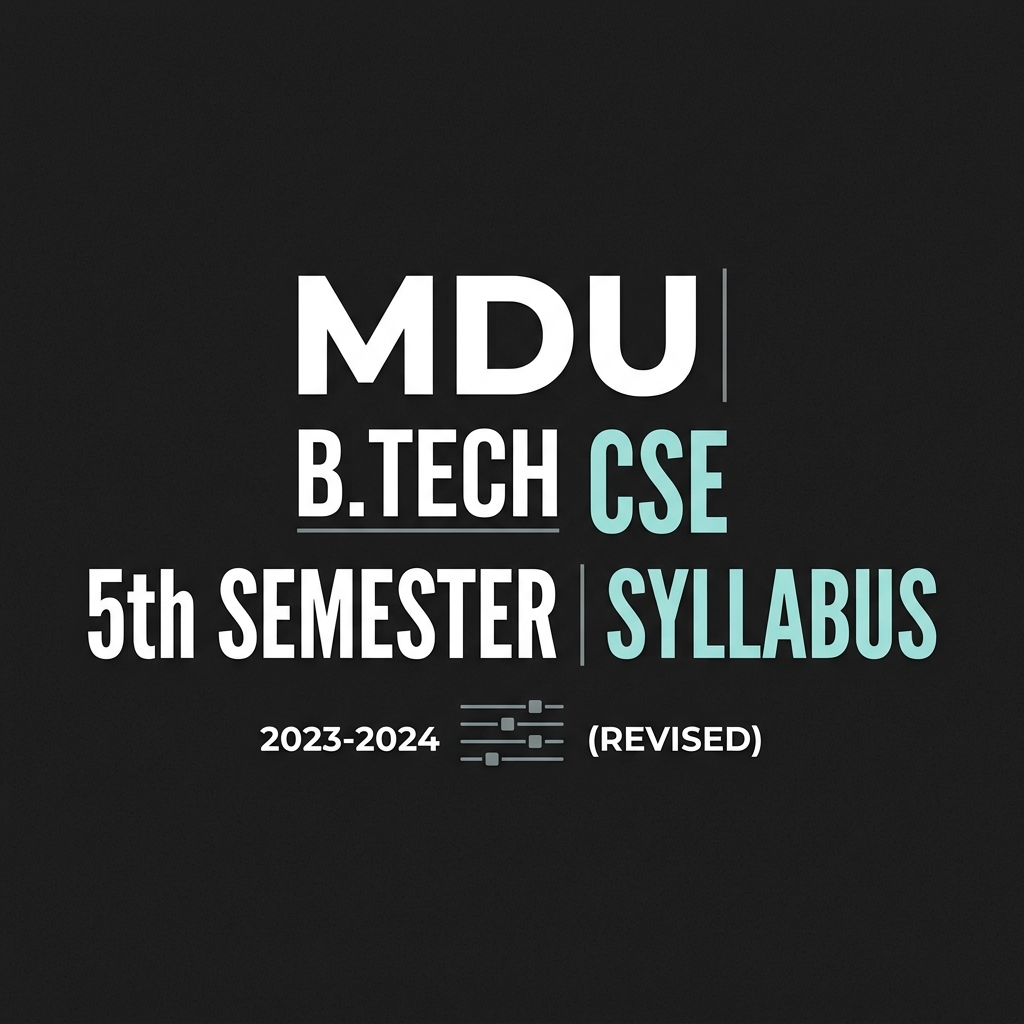
A comprehensive and detailed breakdown of the MDU B.Tech Computer Science & Engineering 5th semester syllabus, including all units, topics, labs, and electives.
Welcome to the 5th semester of your B.Tech in Computer Science & Engineering at MDU! This semester introduces core computer science subjects that are essential for both university exams and your future career as a software engineer.
Below is the complete scheme of studies and examination for the 5th semester (w.e.f 2020-21), fully detailed unit by unit so you know exactly what to study.
Unit 1: The 8085 Processor Introduction to microprocessor, 8085 microprocessor: Architecture, instruction set, interrupt structure, and Assembly language programming.
Unit 2: The 8086 Microprocessor Architecture Architecture, block diagram of 8086, details of sub-blocks such as EU, BIU; memory segmentation and physical address computations, program relocation, addressing modes, instruction formats, pin diagram and description of various signals.
Unit 3: Instruction Set of 8086 Instruction execution timing, assembler instruction format, data transfer instructions, arithmetic instructions, branch instructions, looping instructions, NOP and HLT instructions, flag manipulation instructions, logical instructions, shift and rotate instructions, directives and operators, programming examples.
Unit 4: Interfacing Device 8255 Programmable peripheral interface, interfacing keyboard and seven segment display, 8254 (8253) programmable interval timer, 8259A programmable interrupt controller, Direct Memory Access and 8237 DMA controller.
Unit 1: Introduction & Physical/Data Link Layers Data communication, Components, Computer networks and its historical development, distributed processing, Internet. OSI model and TCP/IP Model. Physical layer functions, modulation, multiplexing, packet switching. Data link layer functions, MAC addressing, framing, ARQ protocols.
Unit 2: MAC, Network Layer & Devices MAC layer functions, random/controlled access. Network layer functions, Logical addressing, IPv4 classful and classless addressing, subnetting, NAT, ICMPv4, ARP, DHCP, IPv6. Network Devices: Repeater, hub, switch, router and gateway.
Unit 3: Routing, Transport & Application Layers Routing Algorithms (Shortest Path, Distance Vector, Link State). Transport layer functions, UDP, TCP, connection management. Application layer functions, DNS, EMAIL, FTP, HTTP, SNMP.
Unit 4: Quality of Service & Network Security Congestion Control, QoS Improving techniques. LAN Architectures (Ethernet, Token Ring), WAN Architectures (Frame Relay, ATM). Firewalls, security goals, cryptography introduction, symmetric and asymmetric ciphers.
Unit 1: Finite Automata & Machines Set, Alphabet, languages, deterministic finite automata (DFA), Non-Deterministic finite automata (NDFA), Equivalence of DFA and NDFA, minimization of finite automata. Mealy and Moore Machines.
Unit 2: Regular Expressions State and prove Arden’s Method, Regular Expressions, recursive definition, conversion to Finite Automata and vice versa. Pumping lemma for regular languages.
Unit 3: Grammars & Push Down Automata Chomsky hierarchy of languages, Context-free grammar, Derivation tree, Ambiguity removal, Normal Forms (CNF and GNF). Introduction to PDA, Deterministic and Non-Deterministic PDA, design and equivalence with CFG.
Unit 4: Turing Machines & Undecidability Basic model for Turing machines (TM), Design of Turing Machines, Variants of Turing machines, Halting problem, PCP Problem. Church-Turing thesis, universal Turing machine, undecidable problems.
Unit 1: Introduction & Divide and Conquer Algorithm Performance Analysis (Time and Space complexity), Asymptotic Notation (Big OH, Omega and Theta). Sets and Disjoint Set Union. General method, Binary Search, Merge Sort, Quick Sort, Strassen’s Matrix Multiplication.
Unit 2: Greedy Method & Dynamic Programming Fractional Knapsack, Job Sequencing, Minimum Cost Spanning Trees, Single source shortest paths. Dynamic Programming: Optimal Binary Search Trees, 0/1 knapsack, Traveling Salesperson problem.
Unit 3: Back Tracking & Branch and Bound 8-Queen’s problem, Sum of subsets, Graph Colouring, Hamiltonian Cycles. Branch and Bound method, 0/1 knapsack problem, Traveling Salesperson problem efficiency.
Unit 4: NP Hard and NP Complete Problems Basic concepts, Cook’s theorem, NP hard graph problems, NP hard scheduling problems, NP hard code generation problems.
Unit 1: Introduction to Java Evolution of Java, OOP Structure, JVM, JRE and JDK, Client-side Programming, Platform Independency, Security Architecture.
Unit 2: OOPS Implementation
Classes, Objects, Methods, Constructors, Method Overloading, Static vs Dynamic Class loading, Argument Passing, this keyword, Inheritance, Method Overriding. Abstract classes, Interfaces, and Role-based Inheritance.
Unit 3: Threads, Swing & Exception Handling Creating Threads, Thread Priority, Synchronization. Swing class hierarchy, AWT Components, Layout Managers, Event Models. Exception Handling: Try and catch block, throw keyword, Checked and Unchecked Exceptions.
Unit 4: Collection Framework & JDBC List & Set based collection, Iterator, Maps, Hash and Tree based collections, Generics. Database Connectivity Using JDBC: Insert, Delete, Update, and Select. Prepared Statement, Callable Statement, Reflection API.
You must choose one of the following Elective-I courses. All electives carry 3 credits and 100 total marks.
1. Microprocessor Lab (LC-ESC-321G) | 50 Marks | 1 Credit Hands-on experiments related to the 8085/8086 microprocessors architecture and assembly language programming.
2. Computer Networks Lab (LC-CSE-323G) | 50 Marks | 1.5 Credits Hands-on experiments using hardware resources and simulation tools like Cisco Packet Tracer to implement networking concepts.
3. Design & Analysis of Algorithms Using C++ Lab (LC-CSE-325G) | 50 Marks | 1.5 Credits Implementing sorting algorithms, greedy methods (Knapsack, Dijkstra's, Kruskal's), dynamic programming, MSTs, and back tracking (N-Queens) using C++.
4. Programming in Java Lab (LC-CSE-327G) | 50 Marks | 1.5 Credits Writing Java programs to implement OOP concepts, multithreading, customized exceptions, Swings for UI, and servlets.
5. Practical Training 1 (PT-CSE-329G) | Grades (A, B, C, F) At the end of your 4th semester, you were required to do an industrial training. In the 5th semester, this is evaluated based on a seminar, viva-voce, and the training report submitted by you.
The 5th semester is heavily focused on foundational subjects. Algorithms (DAA) and Computer Networks are extremely crucial for product-based company placements and GATE exams. Java provides a solid software engineering and backend programming base.
Make sure to invest time in practical lab sessions—especially coding the algorithms yourself—to solidify these theoretical concepts! Best of luck!