5/22/2026
6
For CS students, mastering the right programming languages is crucial. Learn about Python, Java, JavaScript, and C++, their use-cases, and how to build a strong portfolio.
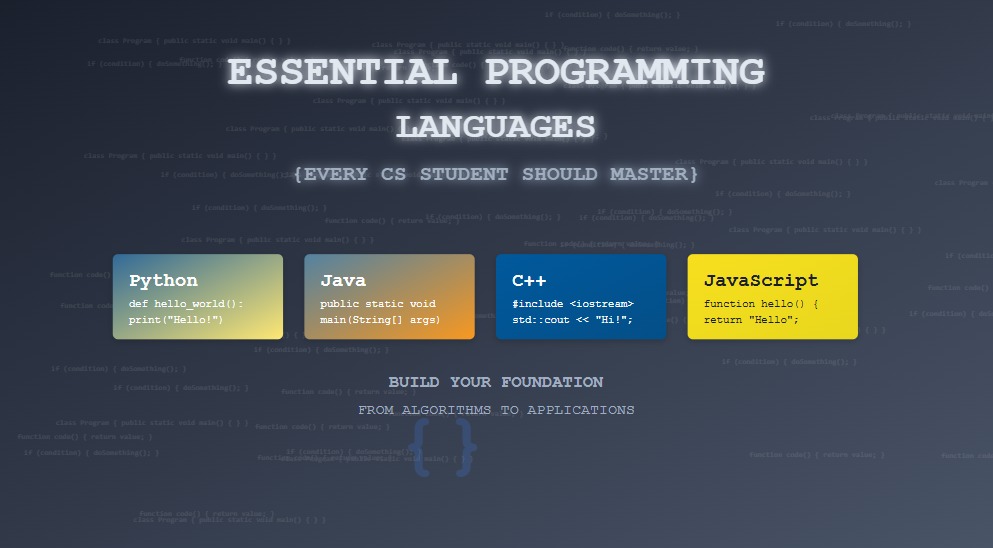
In the fast-moving tech landscape, programming languages are the basic building blocks of software development. For Computer Science (CS) and Information Technology (IT) students, deciding which programming languages to focus on can be confusing. With hundreds of active languages, trying to learn everything often leads to fragmented knowledge.
Rather than memorizing syntax across dozens of platforms, the key is to master a core set of languages that cover different engineering domains: Data Structures, Web Development, Backend Systems, and Database Management.
In this comprehensive guide, we analyze the essential programming languages every engineering student should master and explain how to apply them to build a standout portfolio.
To clear coding rounds during placements, you must have a strong command of Data Structures and Algorithms (DSA). C++ and Java are the industry standard languages for studying DSA due to their object-oriented nature and performance.
#include <iostream>
#include <vector>
#include <algorithm>

int main() {
    std::vector<int> numbers = {5, 2, 9, 1, 56};
    std::sort(numbers.begin(), numbers.end());
    for(int num : numbers) {
        std::cout << num << " ";
    }
    return 0;
}
If you want to build websites, web services, or hybrid mobile apps, JavaScript (JS) is a non-negotiable requirement. JS powers interactive interfaces in web browsers and runs on servers via Node.js, making full-stack web development accessible.
Mastering JavaScript and its TypeScript variant enables you to build full-stack web applications, making you highly marketable to tech startups.
Python is famous for its simple, readable syntax, which mimics plain English. This allows developers to focus on solving problems rather than writing complex syntax rules.
import requests

def fetch_latest_tech_news():
    url = "https://api.hackerwebapp.com/news"
    try:
        response = requests.get(url, timeout=5)
        if response.status_code == 200:
            stories = response.json()[:5]
            for idx, story in enumerate(stories, 1):
                print(f"{idx}. {story['title']} ({story['url']})")
        else:
            print(f"Failed to fetch. Status code: {response.status_code}")
    except requests.exceptions.RequestException as e:
        print(f"An error occurred: {e}")

if __name__ == "__main__":
    fetch_latest_tech_news()
No matter what backend language you write, software applications must store data. Structured Query Language (SQL) is the standard for managing relational databases (such as PostgreSQL, MySQL, or SQL Server).
As you progress through your Computer Science curriculum, you will hear more about newer languages like Rust and Go (Golang). While they are not typically taught in introductory college courses, they are highly sought after by top-tier tech companies.
Created by Google, Go is designed for simplicity, readability, and high concurrency. It has become the language of modern cloud infrastructure, powering major platforms like Docker, Kubernetes, and Terraform. Its lightweight concurrency model (Goroutines) makes it extremely efficient for microservices.
Rust is a systems programming language designed for ultimate safety and performance. It prevents memory errors (like null pointer dereferences or buffer overflows) without using a garbage collector, thanks to its strict "ownership" and "borrowing" rules. It is increasingly being used to write operating system kernels, compilers, and browser engines. Mastering Rust is a massive differentiator on your resume!
Learning a programming language is only the first step. To impress hiring managers, you must showcase your skills through a portfolio of personal projects:
README.md file describing the features, setup commands, and technologies used.TIP
For ideas on structuring your coding projects, browse the Notes Section where we discuss repository organization and software structure.
If you are completely new to programming, Python is a great starting language because of its simple syntax. However, if your immediate goal is to master Data Structures for university exams, C++ or Java is recommended to build a strong foundation in memory management and OOPs.
While not strictly required, learning TypeScript (a strongly-typed layer on top of JavaScript) is highly beneficial. It prevents common bugs during compile time and is the standard for modern Next.js development.
Focus on mastering one language for DSA (C++ or Java), one stack for Web Development (JavaScript/TypeScript), and SQL for database management. Having deep expertise in 2-3 languages is much better than having basic knowledge of 10.
Mastering programming languages is about understanding core concepts rather than memorizing syntax. Once you learn object-oriented principles, loops, and data structures in one language, learning a new one becomes much easier. Focus on building solid foundations, write code daily, and apply your skills to build real-world projects.
Suggested Images:
Futuristic code screen with C++, JS, and Python snippets highlighted, cyber green developer aesthetic).Alt Texts:
Internal Linking Suggestions:
Loading comments...