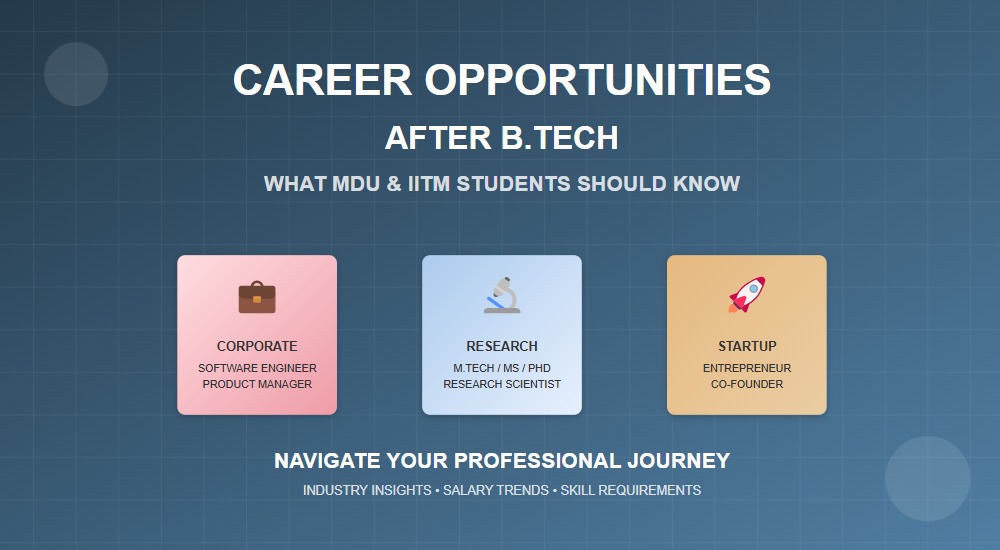
Completing your B.Tech is the start of a new chapter. Explore the major career paths available after graduation, from software engineering to government jobs and higher studies.
Earning a Bachelor of Technology (B.Tech) degree is a major academic milestone. As graduation approaches for students at Maharshi Dayanand University (MDU) and the Institute of Innovation in Technology and Management (IITM), the critical question arises: What next?
The engineering landscape has evolved rapidly over the past few years. While traditional campus placements remain popular, the rise of remote work, artificial intelligence, startups, and specialized higher studies has created a diverse range of career paths.
In this comprehensive guide, we explore the primary career options available after completing your B.Tech, outlining how you can leverage your degree to build a successful career.
For Computer Science (CSE), Information Technology (IT), and Electronics students, the private corporate sector is the most popular route. It offers diverse roles, fast career growth, and excellent compensation packages.
Major Career Profiles:
Full-Stack Developer: Building both the user-facing web interface and the underlying server logic. MERN (MongoDB, Express, React, Node.js) and Next.js are highly sought-after stack skills.
Data Engineer / Analyst: Extracting, processing, and analyzing large datasets. Python, SQL, and database management are critical skills here.
DevOps Engineer: Bridging the gap between software development and IT operations. Focuses on automation, cloud infrastructure (AWS/Azure), and CI/CD pipelines.
UI/UX Designer: Designing user-friendly interfaces. Requires skills in Figma, wireframing, and user research.
Off-Campus Placements: Acing the Modern Job Hunt
If your college campus does not attract your dream product-based companies, do not lose hope. Off-campus recruitment is more accessible than ever if you have a strategic approach:
Optimize Your Resume: Keep your resume to a single page, prioritize your technical skills, and use the Google X-Y-Z formula to describe your project achievements ("Accomplished [X] as measured by [Y], by doing [Z]").
Build a Strong Digital Presence: Ensure your GitHub profile has green contributions, write technical blogs about what you learn, and keep your LinkedIn profile updated.
The Referral Route: Instead of cold-applying to thousands of career portals where resumes get filtered by automated ATS scanners, find software engineers working at your target companies on LinkedIn. Send them a polite message showcasing your portfolio and ask for a referral: "Hi [Name], I recently built a real-time collaborative workspace app using Next.js. I saw an opening for a junior frontend engineer at your company and was wondering if you would be open to reviewing my portfolio for a referral. Thank you!"
2. Higher Education: M.Tech/MS vs. MBA
If you want to deepen your technical expertise or transition into management roles, higher studies is an excellent path.
A. M.Tech / MS (Master of Technology / Master of Science)
Path: Clear the Graduate Aptitude Test in Engineering (GATE) to secure admission in premier Indian institutes like IITs or NITs. Alternatively, take the GRE and TOEFL/IELTS to apply for MS programs abroad.
Best for: Students interested in research, academia, or highly specialized technical fields like Artificial Intelligence, VLSI Design, or Robotics.
B. MBA (Master of Business Administration)
Path: Prepare for the Common Admission Test (CAT) to target prestigious Indian Institutes of Management (IIMs) or take the GMAT for international business schools.
Best for: Engineers who want to move into product management, management consulting, investment banking, or corporate leadership roles.
3. Government Jobs: Civil Services, Defense, and PSUs
For stability, social impact, and job security, government exams are a highly respected option:
Public Sector Undertakings (PSUs): Companies like ONGC, IOCL, BHEL, and NTPC recruit engineering graduates directly based on their GATE scores.
Indian Engineering Services (IES): Conducted by the UPSC, this exam recruits engineers to manage technical departments in railways, roads, and defense sectors.
Defense Services: Join the Army, Navy, or Air Force as a technical officer through entry schemes like University Entry Scheme (UES) or Direct Technical Entry.
Civil Services (IAS/IPS): Many engineering graduates clear the Civil Services Examination (CSE) due to their analytical backgrounds and structured study habits.
4. The Startup Ecosystem and Entrepreneurship
If you want to build your own product and solve real-world problems, launching a startup is a challenging but rewarding path.
Many successful platforms started in college dorm rooms. Building a startup requires:
Identifying a Pain Point: What problem does your target audience face?
Building an MVP (Minimum Viable Product): Use rapid prototyping tools to launch a basic version of your solution.
Pitching to Investors: Present your business model, target market, and growth plans to secure funding.
The Rise of Solopreneurship & Freelancing
In 2026, you don't necessarily need a massive team or VC funding to run a business. The rise of no-code tools, cloud databases, and AI coding assistants has enabled Solopreneurship—where a single developer builds, deploys, and monetizes a software product independently. Additionally, high-end freelancing on platforms like Upwork or Toptal allows skilled engineers to work with global clients, earning competitive hourly rates while maintaining complete schedule control.
Alternatively, joining an early-stage startup as a software engineer offers a fast-paced learning environment where you can take on diverse responsibilities and learn the ropes of business operations quickly.
5. Key Steps to Make Yourself Placement-Ready
To stand out in competitive job markets, start preparing well before graduation:
Maintain a Strong CGPA: Keep your CGPA above 7.0 (or ideally 8.0) to clear the initial cutoff filters of major recruiting companies.
Build Hands-On Projects: Instead of copying basic calculator apps, build complex, deployed web applications that solve actual problems.
TIP
Show project source links clearly on your resume. You can find guidance on project structuring in our Notes Directory.
Practice Technical Interview Coding: Dedicate time to mastering Data Structures and Algorithms. Practice writing dry-runs of recursion, array manipulations, and tree traversals.
6. Frequently Asked Questions (FAQs)
Q1. Can I get a software job if my B.Tech is in a non-CS branch?
Yes! Many software companies recruit mechanical, civil, or electrical engineering students. You must build a strong portfolio, master coding fundamentals (DSA), and showcase projects on GitHub.
Q2. Is a GATE score useful if I don't want to study further?
Yes. A high GATE score is the primary selection criterion for recruitment in major PSUs, which offer excellent salary packages and job security.
Q3. How do I start preparing for placements during my 3rd year?
Start practicing coding questions on platforms like LeetCode or GeeksforGeeks daily. Additionally, build at least two full-stack projects and draft a clean, single-page resume.
7. Conclusion
A B.Tech degree provides a versatile foundation that opens doors to diverse industries. Whether you choose to work in product engineering, pursue management, serve in the public sector, or build a startup, your success depends on continuous learning and strategic planning. Start exploring options early to take the next step in your career with confidence!
Suggested Images:
Featured Image: A collage graphic illustrating career routes (arrows pointing to icons of coding, graduation caps, corporate offices, and government seals) (Prompt: Graphic vector representing career paths, coding icons, graduation caps, and corporate offices, matching green accent aesthetic).
Inline Image: A comparison timeline illustrating the preparation paths for GATE, CAT, and Placement interviews.
Alt Texts:
Featured Image: "Career options and growth paths after BTech graduation"
Inline Image: "Preparation timelines for major post-BTech exams"